
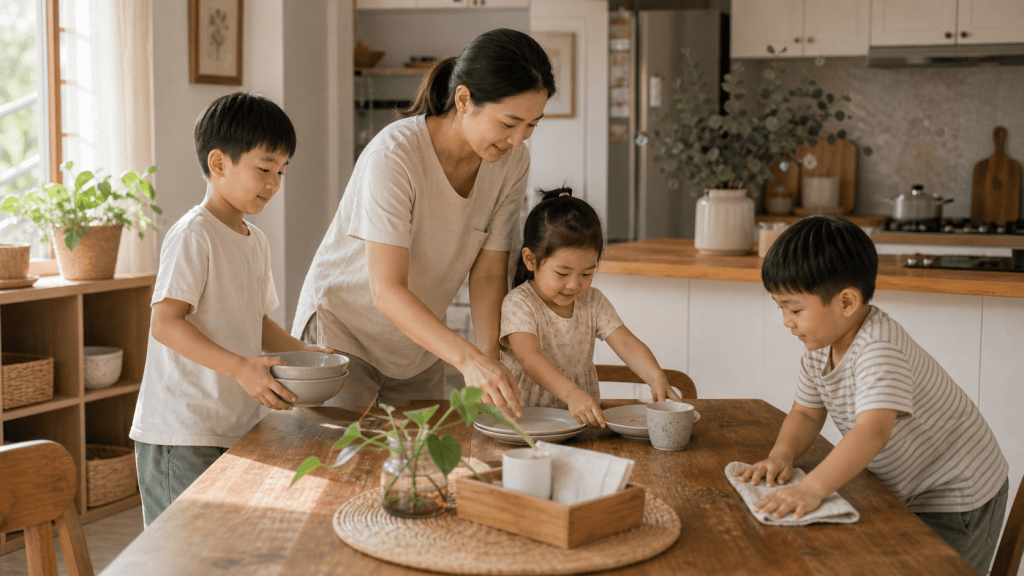
When people hear “children and chores,” they often imagine nagging, resistance, and one more thing for mum to manage.
I understand that. But for me, involving children in chores is not mainly about getting more help. It is about bringing them into the real life of our home so that contribution, order, and care become normal to them over time.
Here’s what we’re going to be talking about:
- Why it is important to involve your children in chores
- What I want them to learn
- Practical tips for setting up the home for ownership
- What this looks like in real life
One of the most humbling mindset shifts for me has been realising that this home is as much theirs as it is mine.
I am not just giving them room and board and expecting them to fit into my comforts and conveniences. A family home should be set up for their comfort, their learning, their growth, and their rest too. Once I started seeing home that way, I began to look at it more from their eye level, their hands, their pace, and their stage of development.
Why it is important to involve your children in chores
I think chores matter because they are one of the most ordinary places children can learn and practice values.
They are learning life skills, of course.
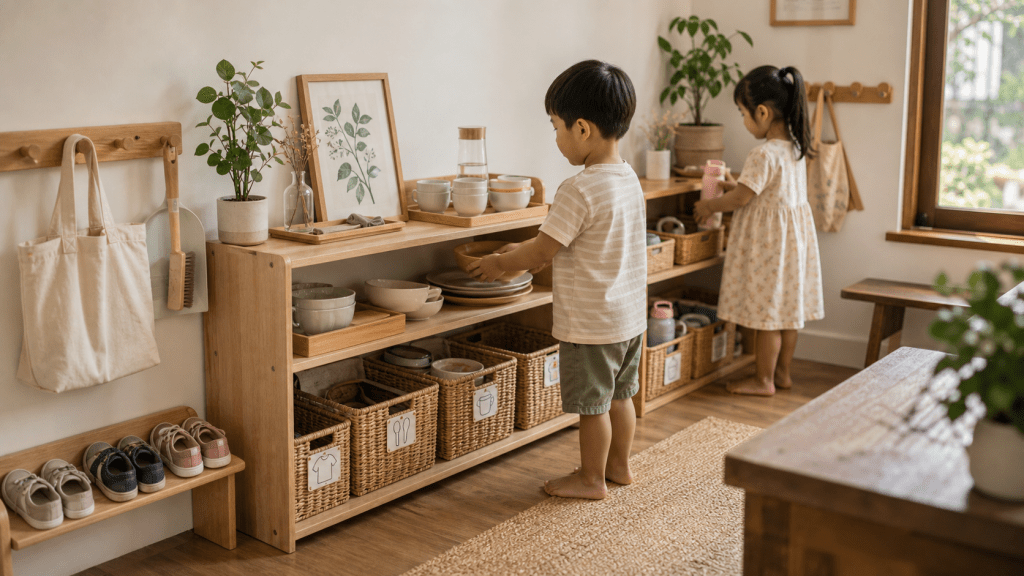
They are learning:
- how to care for their clothes
- how to return things to their place
- how to handle food, dishes, bags, and daily items
- how to notice that homes do not run by magic
But chores are also quietly teaching order.
When a child clears a plate, wipes a table, returns a cup, or puts shoes back in the same spot each day, they are learning sequence, follow-through, and the idea that things belong somewhere. That kind of orderliness is not only good for the home. It shapes the child too.
I also think chores are one of the quiet places early literacy and math begin to make sense in real life.
They see and use labels. They sort by category. They match lids to containers. They count napkins, cups, and plates. They compare full and empty. They follow steps in order. They begin to understand that practical life is full of patterns, language, quantity, and sequence.
And then there is the habit training side of it.
Chores help train:
- integrity
- attention
- orderliness
- persistence
- doing a small job properly
- the habit of responding when something needs to be done
That matters to me because I do not just want children who can complete tasks. I want children who can notice, respond, and do their best with ordinary responsibilities.
And underneath all of that is virtue training.
When we teach children to care for what comes through their hands, we are teaching stewardship. When we teach them to make the most of what they have, we are teaching gratitude. When we teach them to help care for a shared space, we are teaching service, responsibility, and love made visible.
When I think about chores this way, I stop asking only, “How can I get more help?” and start asking questions like:
- What habits are being formed through this ordinary repetition?
- What kind of order is my child learning here?
- What character is being quietly built by this task?
What I want them to learn
For me, this is not mainly about raising helpful children. It is about forming the kind of family culture we live inside every day.
I want the home to communicate:
- you belong here
- your comfort matters here
- your learning matters here
- your growth matters here
- your rest matters here
That changes how I think about space, routine, tools, expectations, and even what counts as progress.
The family planning workbook includes a vision-planning for you and your husband to work through:
- what values are important to you
- how do you want you and your children to feel in the home
- what does a home look and feel like
When you know where you’re heading towards, you’re clearer, more grounded and more united.
Bonding
I want chores to create more togetherness, not less.
There is something very ordinary and very connecting about washing dishes side by side, folding clothes together, packing a lunch together, or resetting a room before the next part of the day. Small conversations happen there. Shared work happens there.
I don’t believe in glorifying the mental load or that there should be keeping of scores. It’s about improving communication, cultivating shared respect and understanding. Managing the home life is a perfect place to start. It happens daily and it affects everyone in the family.
The child learns, “Family life is something I participate in, not something that is done around me.”
Ownership
I want the children to learn that our home is not only mum’s responsibility.
I want them to feel:
- this is our home
- my actions affect the people around me
- I can contribute here
- I can care for what I use every day
That kind of ownership changes the emotional tone of the home. It moves us away from constant reminders and toward a stronger sense of belonging.
Practical tips for setting up the home for ownership
I do not start with a long chore chart.
I start with setup, and then I keep observing.
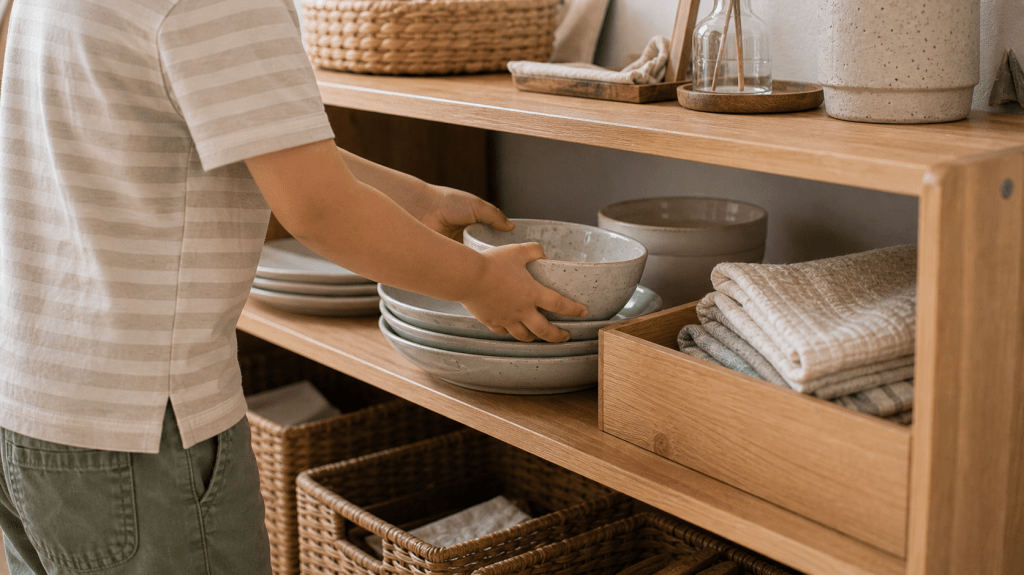
Keep daily things low and reachable
If I want the children to act with more independence, the space itself has to make that possible.
That means cups, bowls, trays, cloths, shoes, bags, water bottles, and daily items need to be where they can actually reach and return them. A child who cannot access the system cannot really take ownership of it.
Use child-friendly tools
Children do better when the tools fit their size and strength.
Small cloths, light trays, low hooks, a small watering can, manageable baskets, or a step stool can make a task feel realistic instead of frustrating. The goal is not to make everything miniature. The goal is to remove unnecessary friction.
In the kitchen, that might mean a learning tower so a child can safely stand beside you at counter height, a
child-safe knife for simple food prep, or a set of
child-friendly kitchen tools that make contribution feel possible instead of performative.
Child-friendly tools also mean that you can feel more at ease in allowing the children to try, experiment and “fail” without you holding your breath on another step.
Another important part here is ongoing observation.
You do not need a perfect understanding of your child before you get started. You begin with the idea of encouraging independence, and then you watch what the setup is telling you.
When something is not working, I try to ask:
- Is it low enough?
- Can they actually reach it?
- Can they work the tool safely?
- Is this a skill issue or a setup issue?
- Is the grip too hard, too tight, or too fiddly for their hands?
- Do they need more fine motor strength, such as pincer grasp or hand strength?
- Have I actually shown them how to do it?
Sometimes the problem is not unwillingness at all. Sometimes the child simply has not yet developed the hand skill, strength, coordination, or confidence the task requires.
Make the sequence predictable
A predictable sequence helps children know what comes next without needing fresh instructions every time.
Another part of learning a chore is learning the order of the chore.
For example, “clean the toys” is not one step. It may mean:
- get a cloth
- wipe the toy or shelf
- put the toy back where it belongs
- return the cloth when finished
Children often need the sequence made visible and logical before they can carry the task more independently.
For other parts of the day, that may look like:
- after breakfast: clear plate, wipe table, push chair in
- when we come home: shoes, bottles, bags, then rest
- before bed: quick room reset, dirty clothes in hamper, prepare for tomorrow
The more repeatable the sequence is, the more likely the child can eventually carry it himself.
Our Involving Children At Home: Printable Pack includes daily chores such as scrambling an egg, preparing your snack and clearing out the laundry broken up into individual, simpler tasks.
All of these shown in pictorial form.
Build chores into a routine
I have found that chores work best when they belong to an existing rhythm instead of appearing as random interruptions.
That does not mean the day has to feel rigid.
I am not trying to create a harsh timetable that everyone anxiously follows. I am trying to create a general rhythm that is predictable, sensible, and fitting for the energy of the day, so it actually feels more joyful and pleasing for the child to move through.
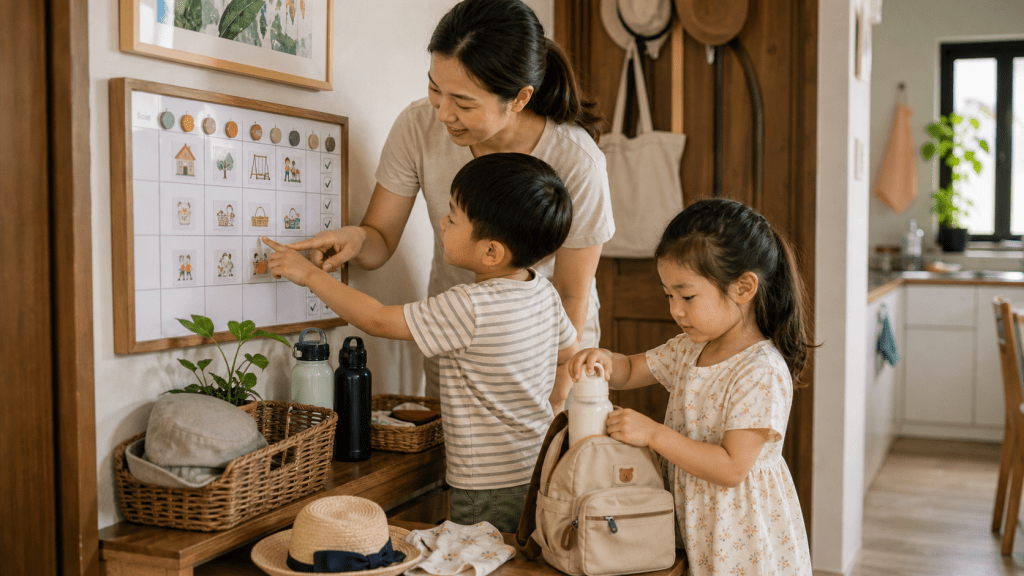
Planning the week together helps with this. A family-facing weekly calendar helps children see whether we are staying home, meeting friends, going out for sand play, or visiting somewhere like a museum. Even that begins to teach them to think ahead.
Then, before an outing, we can work through what is actually needed for today:
- bag
- travel card or bus card
- water bottle
- hat
- change of clothes
That kind of visible planning helps children learn not only to obey a plan, but to think and prepare for themselves.
Morning routines matter here too. A simple visual routine can help with things like:
- brushing teeth
- changing clothes
- making the bed
- eating breakfast
- packing for the day
- getting shoes, bottles, or bags ready
These are not glamorous things, but they are some of the habits that quietly refresh the child and strengthen the family day after day.
Use simple words and visible cues
I also think it is important to explain the principles behind what we are doing.
The values we hold are meant to stretch across all of life, not just live in abstract lessons. That is why even seemingly simple and mundane things like homemaking can become part of education and discipleship.
I repeat a few phrases often:
- this is all of our home
- where does this belong?
- what do you notice needs attention?
- we take good care of what comes through our hands
- we make the most of what we have
When I want to explain stewardship, I might say, “We take good care of everything that comes through our hands.”
When I want to explain contentment, I might say, “We make the most of what we have.” It is a way of training gratitude instead of grumbling.
Picture labels, named baskets, clear homes, and simple display pages help those words become practical instead of remaining vague.
Tools that make this easier
I do not think more products automatically solve homemaking, but some tools do make ownership easier to practise every day.
Glass containers for prep-ahead family meals
- For trays, bowls, storage, labels, and other kid-friendly home items I use, you can browse my
Shopee storefront
What this looks like in real life
This does not usually look grand or impressive.
It looks like:
- standing in the learning tower while helping me rinse produce or stir something simple
- slicing softer food with a child-safe knife while I handle the hotter or sharper parts
- using child-friendly kitchen tools to stir, scoop, pour, or transfer something real
- putting bags back in their family box when we come home
- returning cups and bowls after snack time
- talking through whether today needs a hat, bottle, or change of clothes before we leave
- carrying a tray to the table
- helping pack lunches or water bottles
- putting dirty clothes into the hamper
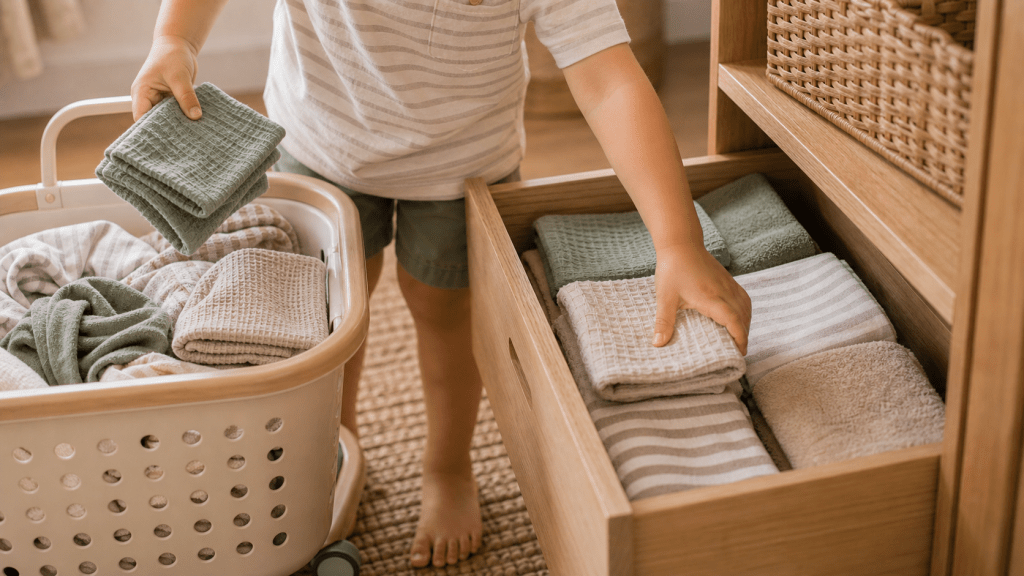
- helping move laundry in a basket that is easier to carry or roll
- folding or returning their own clothes
- wiping a low surface
- getting a cloth, cleaning a toy or shelf, and returning both the item and the cloth
- putting toys and books back where they belong
- helping reset a room before the next part of the day
I also do not expect the same thing from each child at each stage.
A younger child may wipe the table, return a cup, or carry something light. An older child may prepare more of their own things, help with lunch, or handle a more complete room reset.
The point is not pressure.
The point is participation.
If this feels heavy right now, I would not start with everything. I would pick one area of home life and make it more possible for your child to join you there.
You could start with reflection questions like:
- What part of home life does my child already want to join?
- What setup change would make independence more possible?
- Is the tool right for their hands and stage?
- What sequence do I need to make clearer?
- What phrase or principle do I want to repeat in this area?
- What one rhythm would reduce my reminding the most?
Start with one repeatable rhythm, one better setup, and one simple expectation.
If you want help making all of this more visible, the Involving Children At Home: Printable Pack includes chore charts, a weekly family calendar, morning and evening routine charts, family-language display pages, fridge sheets, and labels you can keep visible around the home. It is meant to help you build these rhythms in a way that feels more shared, more practical, and easier to keep.
Related Posts
- How I Feed a Family of 5 Healthy Home-Cooked Meals Without Spending All Day in the Kitchen
- How I Build Structure Into Our Days With Young Children
- Homeschool Kindergarten & Preschool: What I Prioritise
Affiliate note: If you buy something through our links, we may earn an affiliate commission at no cost to you. We only recommend products we genuinely like. Thank you so much.


Leave a Reply